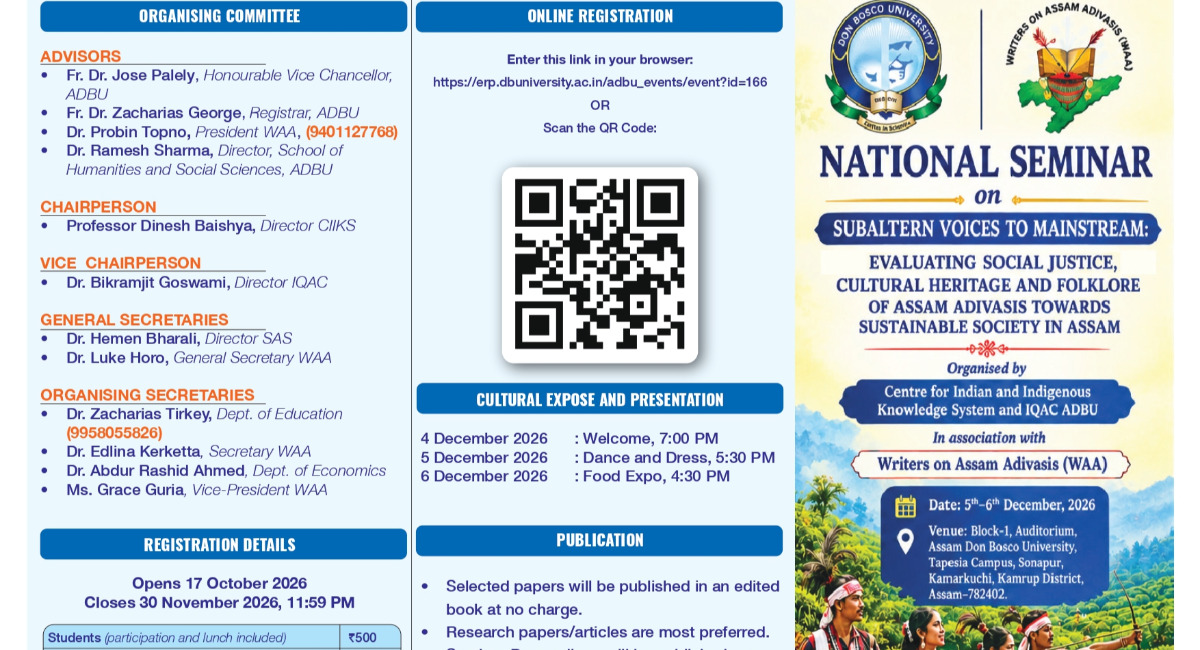
National Seminar on Adivasi Culture, Language, and Customs: Focus on the Adivasis of Assam
About the Event
Concept Note & Seminar Write-ups
Adivasis of Assam & Demographics
The Adivasi community of Assam forms a highly distinctive socio-cultural and economic component of Northeast India. Historically migrating to the region primarily during the colonial era to work in the burgeoning tea plantations, these communities have retained a rich ancestral identity while anchoring themselves deeply into local landscapes. Demographically, they are majorly concentrated across the expansive tea-manufacturing belts of districts like Dibrugarh, Tinsukia, Sonitpur, Kokrajhar, and Kamrup, balancing a rich cultural footprint with contemporary structural trajectories.
Economic Conditions & Tea Garden Realities
The economic framework of the Assam Adivasis remains heavily intertwined with the tea-plantation industry. However, generational challenges such as low or stagnant wage policies, lack of structural land ownership rights, and agrarian vulnerabilities continue to restrain their baseline socio-economic progress. The proposed seminar explores empirical research around alternative sustainable livelihoods, labor wage policies, and macro-economic interventions required for their community upliftment.
Education Trajectories & Access Gaps
While literary levels among the youth have seen marginal positive progress, deep-seated structural issues like high primary-school dropout rates, digital divides, and restricted access to higher education institutes persist. Exploring target scholarship schemes, institutional inclusion models, and specialized pedagogical frameworks at local regional levels remains central to fostering sustainable academic development.
Social and Cultural Fabric
Adivasi social life highlights a vibrant emphasis on communal harmony, egalitarian kinship systems, and gender-inclusive social customs. Culturally, their historical heritage is dynamically articulated through unique performative arts, oral literature, and folk songs. Grand community celebrations like Karam Puja and Sohrai reflect their distinct social solidarity and deep ecological links.
Languages, Customs, and Traditions
The linguistic domain of Assam's Adivasis is remarkably rich yet vulnerable, encompassing ancestral indigenous dialects like Sadri, Santhali, Kurukh, and Mundari. These languages encounter significant pressure from rapid linguistic integration. Analyzing their unique customary laws, traditional village self-governance platforms, and ancestral conservation values offers rich baseline knowledge for modern public policy.
No additional articles posted yet.
Event Details
DATE
December 5, 2026 - December 6, 2026
TIME
—
PARTICIPATION MODE
OFFLINE
Registration Fees
Students Participants
₹500.00
Student Registration for participation and it includes lunch
Capacity: 100
Research Scholars and Academicians
₹1,500.00
Registration fee, paper presentation including 2 lunch
Capacity: 50
Students
₹1,000.00
Students (registration, paper presentation and lunch included)
Capacity: 50
Other Professionals
₹2,000.00
Other Professionals (registration, paper presentation and lunch included)
Capacity: 50