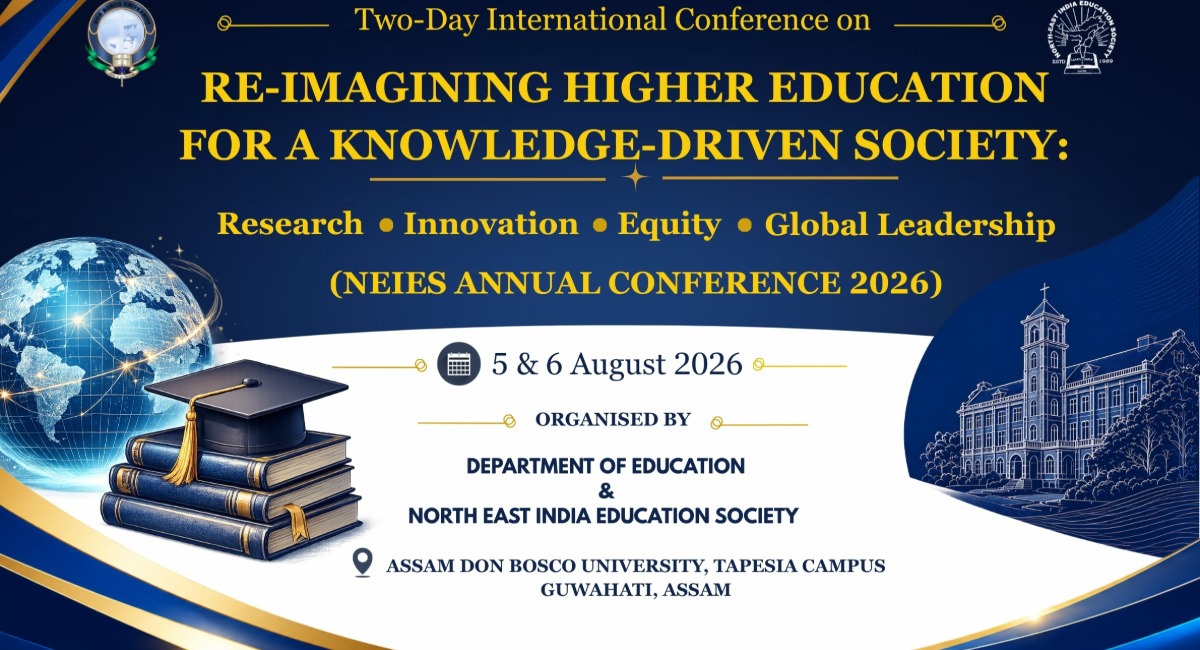
TWO DAY INTERNATIONAL 30TH NEIES ANNUAL CONFERENCE 2026
About the Event
India is undergoing a major transformation in higher education, driven by the vision of becoming a knowledge-based society that supports economic growth and inclusive, sustainable development. Key reforms under NEP 2020 and initiatives like PM-USHA focus on improving access, equity, quality, innovation, and global competitiveness. As India approaches five years of NEP 2020, the 5th National Conference of Chief Secretaries aims to strengthen “Human Capital for Viksit Bharat” by aligning higher education with national and global priorities. The conference provides a platform for diverse stakeholders to discuss critical issues such as research and innovation, interdisciplinary learning, integration of Indian Knowledge Systems, and the use of technology for accessible and future-ready education. It also emphasizes equity and inclusion, institutional quality, faculty and infrastructure development, and enhancing employability through industry-academia collaboration and entrepreneurship. Additionally, themes like
India is on the cusp of a significant transformation in higher education, with a clear goal of becoming a knowledge-driven society that both powers economic growth and promotes inclusive, sustainable development. The implementation of the National Education Policy (NEP) 2020 and flagship initiatives such as PM-USHA have given rise to sweeping reforms that emphasize accessibility, equity, quality, innovation, and global competitiveness. As the country prepares for the 5th National Conference of Chief Secretaries and marks five years of NEP 2020, there is a renewed focus on building ‘Human Capital for Viksit Bharat’ through higher education reform that aligns with both national priorities and international best practices. This conference aims to provide a dynamic platform for stakeholders—including policymakers, academic leaders, researchers, industry experts, and grassroots participants— to engage in meaningful dialogues on transitioning India’s higher education sector into an engine of the knowledge economy. The deliberations are structured around key themes such as promoting research and innovation through robust funding, incubation, and industry linkages; overcoming academic silos by fostering interdisciplinary learning and integrating Indian Knowledge Systems; and harnessing technology to make learning more accessible and future-ready via digital platforms, online courses, and smart infrastructure. A core part of the knowledge economy agenda is to enhance equity and inclusion by reaching marginalized and underserved communities, supporting gender parity, and ensuring socioeconomic diversity across campuses. This also involves strengthening institutional quality and accreditation standards, closing gaps in faculty and infrastructure, and systematically raising the capacity of public institutions to global levels. The conference will also emphasize employability by encouraging industryacademia partnerships, hands-on learning, and entrepreneurship, thereby ensuring that graduates are adaptive and industry-ready. Internationalization, global engagement, and the mainstreaming of multilingual and culturally-rooted curricula are further pillars to be explored, positioning India’s higher education landscape as both locally anchored and globally relevant. By convening a broad spectrum of voices and sharing best practices, the event seeks to generate actionable ideas and policy recommendations, catalyze crosssectoral collaborations, and create a roadmap for the next phase of educational transformation. Ultimately, this effort underscores the belief that a robust, inclusive, and innovative higher education system is essential to achieving the vision of a developed, knowledge-powered Bharat, capable of making a lasting impact on the global stage.
No additional articles posted yet.
Event Details
DATE
August 5, 2026 - August 6, 2026
TIME
—
PARTICIPATION MODE
HYBRID
ORGANIZED BY
Department of Education, ADBU & NEIES
This event has concluded