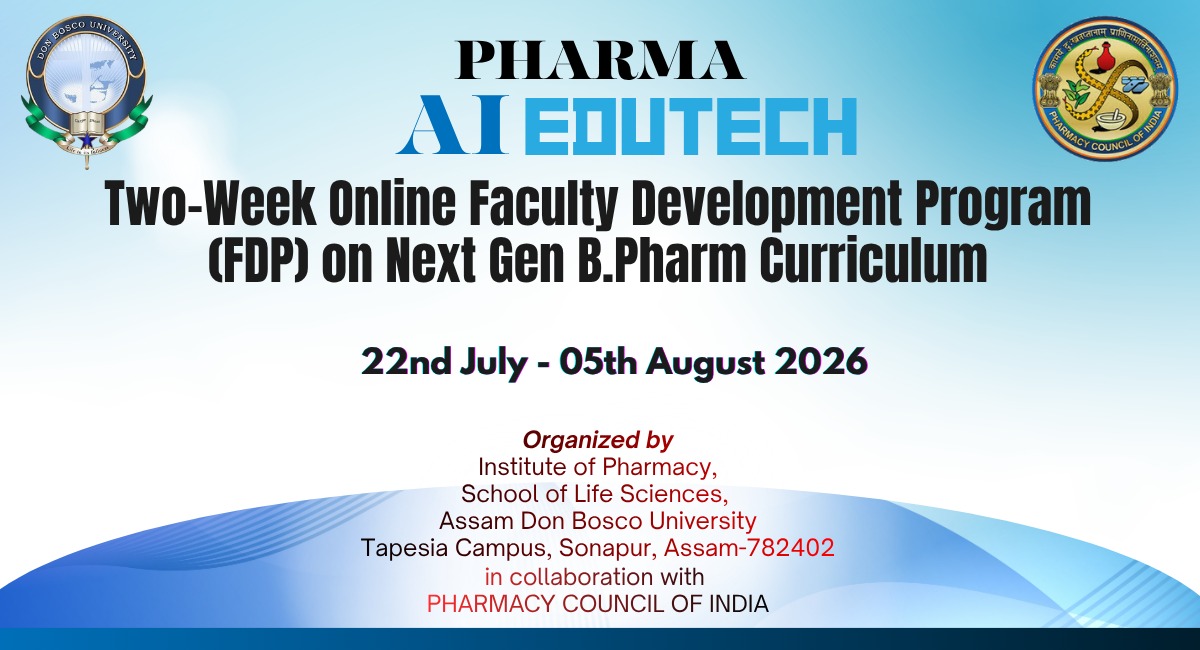
This Two-week Online Faculty Development Programme (FDP) titled “Pharma AI Edutech: FDP on Next Gen B.Pharm Curriculum” is designed to equip pharmacy faculty members with the knowledge, skills, tools, and pedagogical strategies necessary to successfully implement AI-enabled teaching-learning methodologies in pharmaceutical sciences.
This Two-Week Online Faculty Development Programme (FDP) titled “Pharma AI Edutech: FDP on Next Gen B.Pharm Curriculum” is designed to equip pharmacy faculty members with the knowledge, skills, tools, and pedagogical strategies necessary to successfully implement AI-enabled teaching-learning methodologies in pharmaceutical sciences. The FDP aims to bridge the gap between traditional pharmacy education and emerging computational technologies by introducing educators to AI-driven learning systems, machine learning concepts, generative AI tools, digital pedagogy, healthcare analytics, pharmaceutical data science, and technology-enabled curriculum delivery. The programme will provide practical exposure to implementing AI and ML within the framework of the newly introduced PCI syllabus for B.Pharm and related pharmacy programmes.
Objectives of the Faculty Development Programme
July 22, 2026 - August 5, 2026
—
ONLINE
Institute of Pharmacy, ADBU in collaboration with PCI
This event has concluded
2026-07-22
2026-07-23
Navigation of computer operating systems, file architecture, and system properties. Setting up IDEs (Jupyter Notebook, VS Code, PyCharm). Installing, managing, and troubleshooting third-party libraries using pip package manager. Introduction to core Python syntax, standard variables, basic data types (integers, floats, strings, booleans), and explicit type casting operations.
Conditional flow branches (if, if-else, if-elif-else) and nested conditional frameworks. Execution loops (for, while) with explicit break and continue interruption parameters. Designing and modularizing custom functions, parameter passing mechanics, and clean return values. Developing script architectures tailored for fundamental pharmaceutical calculations (e.g., standard dosage adjustment formulas and Body Mass Index (BMI) computations).
2026-07-24
Structured multi-element objects: Lists, tuples, and dictionaries. Practical operations including indexing matrices, array slicing, data element mutation, and advanced string manipulation methods. Introduction to multi-dimensional data management via NumPy arrays. Executing mathematical and vector operations on arrays, dataset alignment, and setting up initial structured arrays for biological tracking.
Introduction to the core architecture of Pandas Series and DataFrames. Reading and mapping complex data architectures from CSV and Excel external files (focusing on structured Pharmacokinetic (PK) tracking files and Adverse Drug Reaction (ADR) pharmacovigilance logging spreadsheets). Inspecting and filtering raw sheets using head(), tail, info, and description. Advanced cleaning methodologies, managing missing cells, and structural data aggregation.
2026-07-27
Principles of graphical visualization in pharmaceutical documentation. Generating single and multi-panel charts: line plots, scatter displays, histograms, and box plots. Explicitly labeling chart attributes, design axes, map legends, and graph titles. Plotting real-world pharmaceutical parameters including blood plasma drug concentration-time curves (Oral vs. IV profiles), raw dissolution curves, and active ADR notification charts.
Classification of mathematical data profiles in healthcare research: Nominal, ordinal, interval, and ratio formats. Mapping sources of industrial data streams (clinical trial blocks, pharmacovigilance reports, quality control records, and PK datasets). Calculating and interpreting measures of central tendency (mean, median, mode) and dispersion matrices (range, variance, standard deviation). Understanding asymmetry via skewness calculations implemented through NumPy and Pandas loops.
2026-07-28
Core probability concepts: Addition rules, multiplication logic, and conditional probability profiles. Clinical optimization via Bayes' theorem for diagnostic evaluation. Differentiating discrete and continuous random variables. Modeling biological metrics using Normal distributions, tracking trial statistics via Binomial paths, and predicting rare clinical reactions (ADRs) with Poisson distribution parameters. Visualizing distribution profiles in Python libraries.
Differentiating population attributes from sample subsets. Sampling models deployed in clinical trial designs, identifying selection bias, and calculating standard sampling errors. Conceptual mastery of the Central Limit Theorem. Constructing and evaluating Confidence Intervals. Establishing formal hypothesis tests: Null (H0) vs. Alternative (H1) frameworks, evaluating Type I and Type II error weights, interpreting p-values, and calculating alpha limits on pharmacy trial sheets.
2026-07-29
Quantifying structural parameters via Pearson correlation coefficients. Graphing directional associations using scatter views and trend verification (e.g., plotting early dose-response matrices). Designing Simple Linear Regression curves, deriving model regression coefficients, calculating residuals, and establishing goodness-of-fit metrics. Introduction to Odds Ratios (OR) for predictive clinical risk assessment.
Core principles of Unsupervised Learning and algorithmic data exploration without target label structures. Deep dive into K-Means clustering logic: Understanding distance-based groupings, managing centroid placement, and selecting optimal cluster totals using the elbow method. Interpreting clustering output files for patient stratification, market segmentation models, and grouping drug candidates based on chemical/structural properties.
2026-07-30
Deploying Linear and Multiple Linear Regression models for continuous target outputs using Scikit-Learn. Deriving and interpreting multi-variable model coefficients. Analyzing residual distributions and evaluating regression quality via error metrics: Mean Squared Error (MSE), Root Mean Squared Error (RMSE), and R-squared coefficient metrics. Case applications: Modeling automated drug dissolution runtimes, predicting micro-dosage outcomes, and calculating automated PK parameters.
Deploying classification models for discrete, categorical target tracking. Implementing Logistic Regression: Generating raw probability outputs and adjusting classification cut-off thresholds. Evaluating predictive quality through the construction of Confusion Matrices. Parsing core binary performance criteria: Accuracy scores, sensitivity profiles, specificity limits, model precision, and recall rates. Evaluating operational capability using ROC curves and AUC tracking for clinical risk prediction.
2026-07-31
Structural design of Decision Trees, mapping node splitting logic, and tracing analytical decision paths. Evaluating feature importance metrics to locate high-impact variables in pharmaceutical datasets. Moving from individual tree structures to Ensemble Learning via Random Forests. Discussing the computing limits, scaling issues, and advantages/limitations of tree-based architectures across complex clinical datasets (e.g., ADR risk stratification).
Defining the distinct parameters of Artificial Intelligence, Machine Learning, and active Data Science. Mapping learning styles: Supervised model building, Unsupervised data mining, and Reinforcement loop behaviors. Defining structured arrays: Data features vs. objective labels. Architectural layout of an end-to-end ML workflow. Designing rigorous validation paths: Train-test splitting ratios, managing model overfitting/underfitting, and balancing the bias-variance trade-off matrix.
2026-08-03
Digitizing and structuring botanical data profiles: Morphological features, microscopic metrics, phytochemical fingerprints, and high-throughput chromatographic run sheets. Deploying classification models to detect herbal adulteration and verify crude drug authentication. Using regression equations to predict secondary metabolite yields and prioritizing crude extracts for high-throughput screening runs.
Translating molecular structures into machine-readable numerical formats. Constructing digital chemical arrays using molecular descriptors (Molecular Weight, logP, Hydrogen Bond Donors/Acceptors, Topological Polar Surface Area). Connecting chemical arrays to biological targets via Quantitative Structure-Activity Relationship (QSAR) models. Building predictive models for IC50 validation, solubility parameters, and initial ADMET/toxicity filtering.
2026-08-04
Applying predictive models to preformulation and active dosage form development. Designing machine learning workflows for excipient compatibility screening and structural ratio selection. Deploying regression loops to map dissolution data profiles and predict shelf-life decay paths via automated stability trend forecasting. Discussing the boundary conditions, extrapolation limits, and operational gaps of ML modeling within formulation data fields.
Digital data collection streams across manufacturing lines. Correlating Critical Process Parameters (CPPs) directly with Critical Quality Attributes (CQAs). Deploying automated classification algorithms (logistic regression blocks) to execute real-time batch pass/fail verification. Understanding feature importance metrics for predictive equipment maintenance, tracking process variance, and introducing foundational automation architectures (PLCs and SCADA networks).
2026-08-05
Introduction to multi-variable analytical data assessment (Chemometrics). Constructing automated classification models for separating authentic drug batches from counterfeit or substandard formulations using raw spectroscopic data matrices (UV, FTIR, and NIR charts). Modeling chromatographic peak characteristics and processing baseline data noise and measurement variation to secure high-precision quality control loops.
Managing the end-to-end AI deployment life cycle: Data preprocessing, cross-validation protocols, live model deployment, and performance monitoring. Detecting and mitigating model drift and data leakage. Navigating global regulatory guidelines (FDA, CDSCO frameworks, and the EU AI Act) for AI components in regulatory files. Securing data integrity, tracking 21 CFR Part 11 parameters, implementing Explainable AI (XAI) for transparency, and addressing systemic bias in health datasets.